Indochina Now and Then by George Fetherling
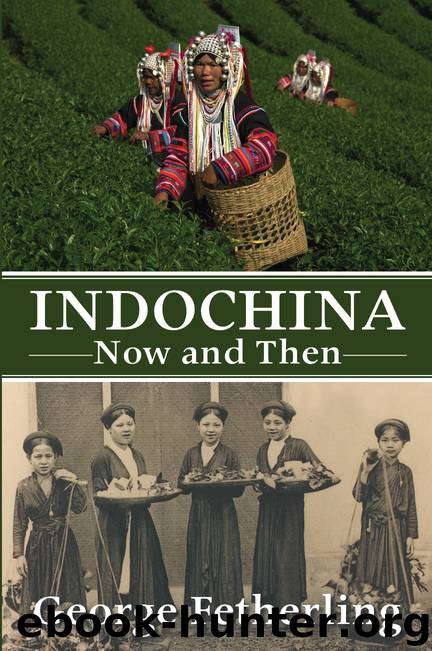
Author:George Fetherling
Language: eng
Format: epub
Publisher: Dundurn
Published: 2012-02-16T16:00:00+00:00
— AMONG THE HMONG —
I was full of questions about the Hmong that I hoped Khan could answer, but he couldn’t. He turned out to be less than expert in his Local Knowledge. For example, within sight of the largest collection of jars is a ruined and abandoned temple. It is a tower made of blocks of laterite, wide at the base, but redented as it rises toward the pointed crown, with each step almost completely covered by who knows how many generations of unchecked plant growth. It certainly looks like the simplest type of Khmer chapel, but in what’s now Laos, the Khmer culture didn’t penetrate farther north than Vientiane. Was this, rather, what’s known as a prang in Thailand, where Khmer ruins are conspicuous in many regions, and, what’s more, left their design influence on Thai Buddhism? Khan seemed to lack even the broadest historical understanding of who was where and when. Maybe the lesson to be gleaned from his deficiencies as a comprador is an awareness that today’s national borders are political, not cultural; that belief systems were passed back and forth, mutating as they did so; and that the French, for better or for worse — and, in some ways, obviously both — were a unifying and codifying cultural force and not merely money-grubbing power-grabbers, though, like all the European colonial powers, they certainly were that, as well.
Khan may have been unable to impart much knowledge even about the abundant Hmong, but he did lead us into their front garden, so to speak. The Hmong are one of the important ethnic minorities of Laos and Thailand. They dislike being called mercenaries, but using a softer term is as much a matter of tact as of accuracy. During the eight years when the U.S. waged a secret war in Laos, using Hmong tribesmen, sometimes in battalion-sized units, to fight the Pathet Lao, the most intense violence took place where we were going now.
We drove to the summit of one of the nearby hills. This was as far as we could travel in Khan’s vehicle as beyond that the road had become a mere muddy rut. We then continued on foot, over meadows with stunted conifers, and, way off in the background, the mountains of Vietnam (Dien Bien Phu is about 125 kilometres away). This description makes it sound pleasant enough, and viewed in broad perspective at the right time of the year it is indeed scenic. But the spot formerly called la Plaine des Jarres must be one of Southeast Asia’s spookiest places, a large, flat region, surrounded by mountains as high as three thousand metres and never completely free of disfiguring mist. The stone jars that litter the site (it’s a marvel that so many survived the bombing, even in pieces) are thought to have been made two thousand years ago, around the time the Hmong first migrated southward from Mongolia, a place of origin that can still be read in their faces. But the ancestors of the Hmong did not produce these jars.
Download
This site does not store any files on its server. We only index and link to content provided by other sites. Please contact the content providers to delete copyright contents if any and email us, we'll remove relevant links or contents immediately.
Waking Up in Heaven: A True Story of Brokenness, Heaven, and Life Again by McVea Crystal & Tresniowski Alex(37813)
Still Foolin’ ’Em by Billy Crystal(36360)
Cecilia; Or, Memoirs of an Heiress — Volume 1 by Fanny Burney(32559)
Cecilia; Or, Memoirs of an Heiress — Volume 2 by Fanny Burney(31957)
Cecilia; Or, Memoirs of an Heiress — Volume 3 by Fanny Burney(31943)
Fanny Burney by Claire Harman(26605)
Empire of the Sikhs by Patwant Singh(23089)
We're Going to Need More Wine by Gabrielle Union(19050)
Hans Sturm: A Soldier's Odyssey on the Eastern Front by Gordon Williamson(18594)
Plagued by Fire by Paul Hendrickson(17416)
Out of India by Michael Foss(16856)
All the Missing Girls by Megan Miranda(16037)
Cat's cradle by Kurt Vonnegut(15362)
Pimp by Iceberg Slim(14515)
For the Love of Europe by Rick Steves(14149)
Molly's Game by Molly Bloom(14146)
Bombshells: Glamour Girls of a Lifetime by Sullivan Steve(14078)
Leonardo da Vinci by Walter Isaacson(13339)
4 3 2 1: A Novel by Paul Auster(12396)
